Prayer
Prayer is the cornerstone of our relationship with Christ. It is crucial to growing and strengthening our interior lives which allows us to live out the Gospel each day. We must spend time in prayer to become closer to Christ, to listen to what he is calling us to do, and to discern every step of our journey to union with Him. Once we have spent time in prayer we are ready to go out and spread the Gospel of Jesus Christ to everyone we encounter.
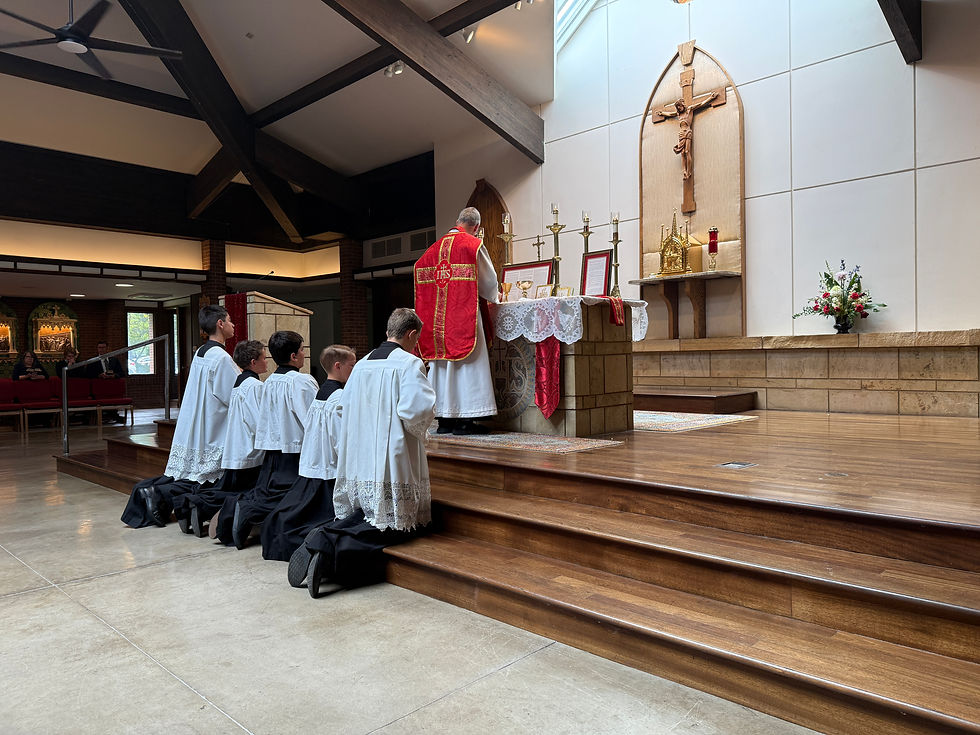
The Mass is the most perfect form of prayer. When we participate in the earthly liturgy we share in a foretaste of the heavenly liturgy. We invite you to discover this immense beauty of the Mass as it is celebrated at Saint John XXIII Catholic Church.
Reconciliation, or confession, is one of the sacraments of healing and God’s mercy. Reconciliation is open to any baptized Catholic who is seeking forgiveness and healing. We have daily confession times, and encourage everyone to make use of this amazing Sacrament.
”This is the wonderful truth, my dear friend: the word, which became flesh two thousand years ago is present today in the Eucharist.” Saint John Paul III
Eucharistic Adoration is a perfect way for you to pray and strengthen your relationship with Christ. We offer Adoration Monday-Friday from 8:30am-8pm. These hours will expand to 10pm Monday-Wednesday and overnight on Thursday and Friday during the school year. Expanded hours will occur once the schedule on filled with regular adorers. Please sign up for an hour with Jesus today!
“The Rosary is the most excellent form of prayer and the most efficacious means of attaining eternal life. It is the remedy for all our evils, the root of all our blessings. There is no more excellent way of praying.” -Pope Leo XIII
We encourage you to pray the rosary often. As a community Saint John XXIII prays the rosary together Monday- Friday at 7:30am
“Nothing we do to defend the human person, no matter how small, is ever unfruitful or forgotten. Our actions touch other lives and move other hearts in ways we can never fully understand in this world. Don’t ever underestimate the beauty and power of the witness you give in your pro-life work.”
-Archbishop Charles ChaputSt John XXIII is a hub for the Northern Colorado prolife efforts and ministry. We are located in walking distance of Planned Parenthood for the many volunteers who pray daily for an end to abortion and we participate in the 40 Days for Life campaigns. Additionally, our students advocate for an end to abortion through the Student’s for Life campaigns.
If you would like to pray in front of Planned Parenthood, signs can be found in the closet across from our single restrooms just south of the front doors.
Learn more about 40 Days for Life campaigns below
https://www.40daysforlife.com/en/fortcollins
40 Days for Life
40 Days for Life starts this Wednesday, March 5. Please, please, please consider signing up to stand witness to the beauty and dignity of life. The kick-off will be Thursday March 6, 2025 at 6 p.m. Please use the following links to access more information about both the kick-off and the vigil.
25_Spring_kickoff_.jpg (1545×2000)
Planned Parenthood
In the past 11 weeks, the Fort Collins Planned Parenthood has sent four (4) women to the hospital.
December 2024: The woman procuring a 22 week abortion had to have surgery at Poudre Valley hospital after a gruesome botched abortion.
January 6, 2025: Ambulance transported a patient to PVH. No further information on the patient.
February 4, 2025: Ambulance transported a patient to PVH. We have confirmation that the 18-year-old patient died at the hospital from complications of the abortion.
February 20, 2025: Another ambulance was called. No information on the patient.
Please keep these women and their families in prayer for physical and spiritual healing. Please also pray for the repose of the soul of the 18-year-old and comfort for her family. May God have mercy on her soul.
We pray for all children who have died in an abortion. May God cradle them in His arms and grant them eternal peace with Him.
Legislation
The legislative session is in full swing with several legislative bills dealing with life issues. Special thanks to Julianna Day for the synopsis and status of the following bills.
ABORTION BILLS
SB25-183 Coverage for Pregnancy-Related Services
Last year, Colorado voters approved Amendment 79, which prohibits denying, impeding or discriminating against abortions. It also eliminated Amendment 3 from the state constitution, which prohibits the use of public funds to pay for abortions. Current law requires the executive director of the department of health care policy and financing to authorize Medicaid reimbursement for family-planning-related services. This bill expands the definition of “family-planning-related services” to include abortion care.
Hearing Schedule: Wednesday, March 5th 1:30 pm | LSB B Judiciary Committee.
SB25-129 Protections for Legally Protected Health Care Activities
This bill will expand Colorado’s “shield laws.” SB25-129 will provide comprehensive protection for individuals and entities involved in abortion and gender affirmation. This bill clarifies the requirements for out-of-state telehealth providers, allowing prescriptions for certain medications, such as abortion pills to include only the name of the medical practice and not the name of the prescribing professional. The bill prohibits Colorado residents and businesses from responding to inquiries or investigations conducted out of state that seek to impose sanctions on individuals or entities that provide gender affirming care or abortions.
Introduced In House – Assigned to Judiciary, but it has not been scheduled, yet.
SB25-130 Providing Emergency Medical Services
On July 11, 2022, under the administration of President Biden, the Department of Health and Human Services issued new guidance stating that abortion was included in EMTALA’s definition of stabilizing care. This bill requires hospital emergency departments to provide abortion services if “necessary to stabilize the patient.” However, it does not include stabilization of a preborn baby.
Hearing has not been scheduled, yet.
PRO-LIFE BILLS
HB25-1252 Colorado Dept of Public Health and Environment Regulation of Abortion Clinics
Concerning the regulation of medical facilities that perform induced abortions after the first trimester of pregnancy.
Hearing Schedule: Wed, March 5, 1:30pm | Health & Human Services HCR 0112.
HB25-1255 Health-Care Provider Right to Exercise Conscience.
The act recognizes that a health-care professional, health-care institution, and health-care payer
(health-care provider) has a right of conscience. Importantly, the legislation emphasizes that the right of conscience is limited to specific procedures, such as abortion, that conflict with a provider’s beliefs and does not exempt providers from their other professional obligations.
Hearing Schedule: Tuesday, March 4, upon Adjournment (around 10am) | Judiciary HCR 0107.
HB25-1251 – Parental Consent to Treatment of a Minor
This bill requires parental consent before a minor may obtain medical services.
Hearing Schedule: Wed, March 5, 1:30pm | Health & Human Services HCR 0112.
HB25-1257 – Relinquishment of Child in Newborn Safety Device
The bill authorizes a fire station, hospital, or community clinic emergency center (authorized facility)
to install a newborn safety device on its premises for parents who voluntarily relinquish their child
who is 60 days old or younger. A newborn safety device must be installed in a conspicuous location at the authorized facility and be equipped with a dual alarm system.
Hearing Schedule: Wed, March 5, 1:30pm | Health & Human Services HCR 0112.
SB25-118 Health Insurance Prenatal Care No Cost-Sharing:
This bill requires health insurance policies in Colorado that provide maternity coverage to offer
prenatal care services without any cost sharing (meaning no co-payments, deductibles, or out-of-
pocket expenses) for policies issued or renewed on or after January 1, 2027. The prenatal care
coverage must include regular office visits, screenings, testing, and monitoring services related to pregnancy.
Introduced In Senate – Assigned to Health & Human Services. Hearing has not been scheduled, yet.
March For Life
The March for Life will be held at the State Capitol on April 11, 2025. See the attached flyer to this email for more information.
If you are interested in attending and would like to carpool to Denver for the March for Life, please let me know.
Your questions and comments are always welcomed!
Thank you for the gift of your prayers and time to our Respect Life Committee.
Our Lady of Guadalupe, patroness of the unborn, pray for us and guide us.
In Jesus through Mary,
Kelly Krapes
Respect Life, St. John XXIII
970 227 7393
Welcome to St. John XXIII Latin Mass Community!
The Traditional Latin Mass is celebrated every Sunday at 11:30 am and Holy Days of Obligation (see bulletin for times)at St. John XXIII Catholic Church, 1220 University Ave, Fort Collins, CO
If you are new to this community or liturgy, take some time to look through the information below and feel free to reach out with any questions. Also, if you would like to be paired to sit with someone for your first few Masses, please let us know at the Welcome table in the Narthex.We are very happy to have newcomers and want to make you feel as welcome as possible.
First time attending?
Attire for Mass
We ask that everyone – men and women – come to Mass dressed modestly. We are in the presence of the King of Kings, and therefore we dress accordingly. While not required, ladies are encouraged to wear a head covering or veil while in the church. Doing so is a traditional devotion indicating humility and purity before God.
Please feel reach out if you would like clothing for Mass (skirt, veil, shirt, slacks, tie). salveregina365@pm.me
Missals
A red booklet missal is provided that contains the prayers of the Mass in both Latin and English to assist you as you pray the Mass. You can usually find a red booklet and a weekly leaflet(these are called Mass Propers) on a table just inside the sanctuary or on the Welcome table in the Narthex. For your first several Masses, you may not want to follow along at all. You may just want to listen, watch and pray.
Seating
Sit towards the front for a better view, but avoid the first three to four pews if you are unfamiliar with the postures. The front pew is reserved for reception of the Eucharist so this pew is left open. Stop by the Welcome table in the Narthex as we are happy to help you sit near someone who can assist you with the postures and the missal. We were all new once and are happy to welcome you and make you feel comfortable.
The Mass
Who may attend the Latin Mass?
Anyone may attend. No special background or membership is required. Catholics of any rite can fulfill their obligation for Mass on Sundays and Holy Days by attending the Traditional Latin Mass.
Language
The priest prays the Mass in Latin, the official language of the Roman Catholic Church. The priest will always preach the homily in English.
Priest faces the altar
The priest faces God in the tabernacle and the altar of sacrificeas he offers the Mass. In this manner, the priest and congregation face God together and unite their prayers during Mass.
Silence
People are quiet as they come into the church to show reverence for the Blessed Sacrament and to prepare themselves for Mass. Silence allows us to reflect upon our relationship with God and allows Him to speak to us. You will also notice periods of silence throughout the Mass where the priest is silently praying.
Following along with the Mass
As mentioned above, red booklet missals and weekly Mass Propers are distributed for those who wish to follow along with the text of most of the Mass. Again, for your first severalLatin Masses, you may not want to follow along at all. You may just want to listen, watch and pray.
Postures
If you are unsure when to stand, sit or kneel, you may follow the instructions in the red booklet missal or just follow the cues of the others around you. Don’t worry if you make a mistake in sitting, standing, or kneeling; follow the congregation.
Responses
The most important form of participation while at Mass is interior prayer. For this reason, the altar servers make most of the responses to the priest, rather than the congregation. During a High Mass, some of the responses may be sung by the congregation.
Communion
At the traditional Latin Mass, one receives Holy Communion while kneeling (if capable) in the front pew nearest the sanctuary. The Host is received on the tongue, not in the hands. Additionally, one does not respond “Amen” to the priest; he will say it for you. The Roman Catholic Church permits baptized Catholics who are in a state of grace to receive Communion. By “state of grace” is meant those who are not conscious of any grave sin which has yet to be absolved by sacramental confession.
Experiencing the Latin Mass
First experiences vary. You may feel moved, confused, or even disapproving. Give yourself time to adjust. The more you learn about the Latin Mass, the more you will appreciate it. Don’t let a negative first impression deter you.
Enjoying the Mass
Relax and lift up your heart and enjoy worshiping in the beauty of His Holy Temple. The Latin Mass can be a profound blessing.With regular attendance, your appreciation for the Mass will grow. It has captivated many Catholics throughout history.
Confession
Confessions may be offered before or during the Traditional Latin Mass, depending on priest availability. Confessions are in English.
After Mass
Those who wish to socialize should do so outside or in the Narthex to respect those still in prayer after Mass.
FAQs
What is the Traditional Latin Mass?
The Traditional Latin Mass (also known as the Tridentine Mass or Extraordinary Form) is the form of the Roman Catholic Mass codified by Pope St. Pius V in 1570, following the Council of Trent. It was the standard Mass of the Roman Rite until the reforms of Pope Paul VI in 1970, which introduced the Novus Ordo (the current ordinary form of the Mass).
Why is it called the "Latin" Mass?
It is called the “Latin” Mass because the entire liturgy is celebrated in Latin, the universal language of the Roman Church. Only the homily and certain announcements may be in English.
Why do some women veil?
While veiling is not required in the Roman Catholic Church, many women choose to veil for many reasons. Here are a few links with more information:
What is the difference between a High Mass and Low Mass of the Latin Mass?
In the Extraordinary Form, there are two primary types of Masses celebrated: the spoken or “Low” Mass, and the “Sung” Mass (sometimes referred to as High Mass).
Low Mass is celebrated by a priest assisted by one or more altar boys. The prayers are spoken (in Latin), and much of the Mass of the Faithful (after the offertory) is almost inaudible, in imitation of the ancient Jewish liturgies given by God to Moses, and emphasizing the fact that we are faced with a profound mystery. A visual sign of a Low Mass is two lighted candles on the altar.
During Low Mass, only the altar servers respond to the priest. The priest alone says the Pater Noster prayer (Our Father), and only he assumes the Orans prayer position (hands extended and held shoulder-width apart).
High Mass may include the Asperges before Mass, in which the priest sprinkles the congregation with Holy Water as part of the opening liturgical ceremony. Sung (High) Mass is so called because many of the prayers of the Mass are sung by the priest, choir, or schola. High Mass also usually employs the use of incense. A visual sign of a High Mass is six lighted candles on the altar.
At Sung Mass, the faithful chant the Kyrie, Gloria, Credo, Sanctus and Agnus Dei with the Schola (choir). The congregation also responds to the Priest in chant during multiple points during the Mass.
Other Resources:
Mass of the Ages: A documentary trilogy on the Traditional Latin Mass
Weekly Mass Propers: This is a great website for printing the Mass Propers. (Print setting = Flip on short edge).
Treasure and Tradition: The Ultimate Guide to the Latin Mass: Great resource book